LAS BAULAS NATIONAL MARINE PARK
The Leatherback Turtles of Playa Grande
For millions of years, the largest turtles on Earth have crossed the Pacific to lay their eggs on this beach. Today only a handful still come, and every one of them matters.
Photo: NOAA (public domain)
Playa Grande is one of the most important nesting beaches in the world for the Pacific leatherback, a critically endangered sea turtle. The whole beach is protected as part of Las Baulas National Marine Park (baula is Spanish for leatherback), and the people who live here have spent decades making sure it stays wild, dark, and quiet for them.
Meet the leatherback
2 m
The largest turtle alive
Adults can grow over 2 meters (6.5 ft) long and weigh more than 500 kilos (1,100 lb).
100M+
Ancient survivors
Leatherbacks belong to a lineage that has survived for over 100 million years.
1,000 m
Deep divers
They can dive deeper than 1,000 meters (3,300 ft) hunting jellyfish, their main food.
95%
Critically endangered
About 1,500 females nested here in 1988–89. Recent seasons have counted only 2 to 8.
A night on the beach
What happens when a leatherback comes ashore.
She comes ashore
Under cover of darkness, a female hauls herself up the beach, often around high tide, looking for the perfect spot above the waterline.
She digs and lays
Using her back flippers, she digs a deep nest and lays around 80 eggs, the size of billiard balls. The whole process can take one to two hours.
She returns to the sea
She covers the nest, disguises it with sand, and heads back to the ocean. She may return to nest several times in one season, about every 9 to 10 days.
The eggs incubate
For about two months, the eggs incubate in the warm sand. The sand temperature decides the sex: warmer nests produce more females.
The hatchlings emerge
The hatchlings dig out together, usually at night, and race toward the brightest horizon, which should be the moonlit sea.
Decades later
Only a tiny fraction survive to adulthood. The females that do will return, years later, to nest on the very same coastline.
Can you see them? The honest answer
Night turtle tours at Playa Grande are suspended. The local guides’ association that ran them with the park stopped the tours in 2019, and the park (SINAC) currently lists no turtle observation. With so few turtles left, the priority is protecting each one.
Nesting season: roughly October to March, with the best chance around November to January. Turtles come ashore at night, often near high tide. There is no set hour, and a turtle may not come up on any given night.
Beaches close at night: the park is open 6 a.m. to 6 p.m. During nesting season, visitors must be off the beach by 5 p.m., and no one may be on the sand at night.
Call before you plan: rules and programs can change from season to season. If you’re hoping to see a turtle, call the Las Baulas park office first: +506 2653-0470.
All contacts and phone numbers ↓
Where to see turtles nearby ↓
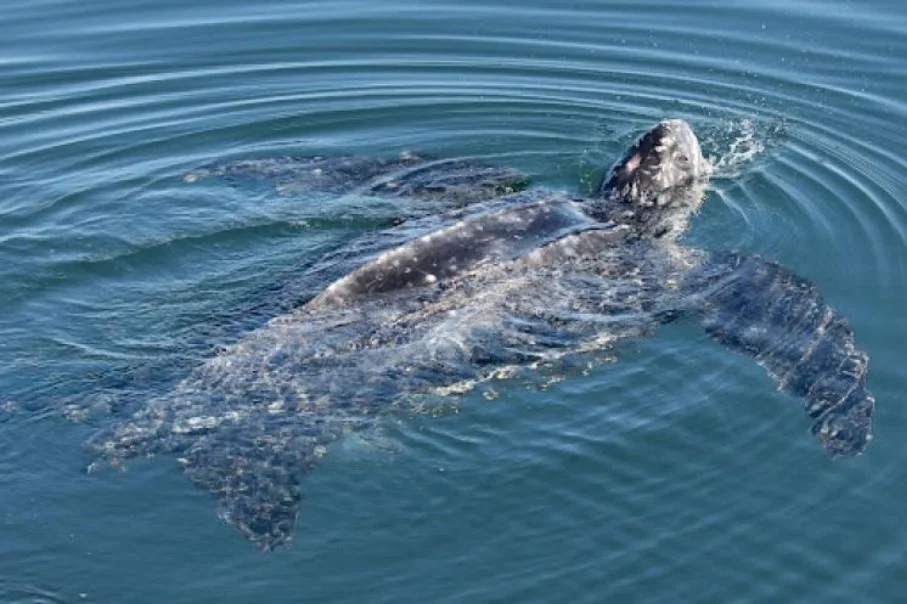
Photo: NOAA Fisheries (public domain)
Why so few turtles now?
In the 1988–89 season, about 1,500 leatherbacks nested in the park, and dozens could be seen on a single night. Recent seasons have counted only 2 to 8 for the whole season, a fall of more than 95%. Researchers point to several causes:
- Egg poaching. For two decades before the park was created, nearly 90% of eggs were taken. Leatherbacks take decades to mature, so the loss showed up years later.
- Fishing at sea. Adults drown in longlines and gillnets, especially in the South Pacific off Chile and Peru.
- Building near the beach. Structures around Playa Grande grew from 47 in 1991 to 487 in 2024.
- Artificial light. Lights from homes and towns confuse nesting females and lead hatchlings inland.
- Dogs and raccoons. Pets on the beach and raccoons drawn by garbage now destroy most nests.
- Hotter sand. Warmer nests hatch fewer turtles, and more of them female.
Source: The Leatherback Trust’s monitoring, summarized by SosGrande (October 2026).
The rules on the beach
No lights at night. No white lights, flashlights, phone screens, or flash photography on the sand after dark. Light confuses nesting females and hatchlings.
Off the beach at night. During nesting season, Playa Grande, Ventanas, Carbón, and Langosta close every evening until early morning.
No dogs, fires, or camping. Dogs dig up nests and chase hatchlings. Pets are not allowed on the nesting beaches.
Keep 5 meters away. If you see a nesting turtle or hatchlings, stay at least 5 m (16 ft) back, stay low and quiet, and keep their path to the sea clear.
Never touch. Don’t touch turtles, eggs, or hatchlings, and never carry a hatchling to the water.
Report it. Seen a turtle, tracks, a nest, or someone breaking the rules? Call the park’s report line: +506 8704-6444.
How you can help
Keep it dark. If you’re staying near the beach, close curtains at night and switch off outdoor lights that face the sand. Hatchlings follow light, and artificial light can lead them inland instead of to the sea.
Leave nothing behind. Leatherbacks mistake plastic bags for jellyfish. Pack out all your trash, and pick up any plastic you see.
Watch your step. Nests aren’t always marked. Avoid digging deep holes or driving anything on the sand.
Support the research. Scientists from The Leatherback Trust have monitored the turtles here for over 30 years, and the community group SosGrande patrols the beach and runs school programs. Both welcome donations and volunteers.
Where to see turtles, the responsible way
You can still get close to sea turtles here, with people who protect them.
Hatchling expeditions with SosGrande
When: January to March.
Work alongside researchers checking nests and helping release hatchlings safely into the ocean. Every booking supports the local conservation work.
Conservation days in Playa Grande
SosGrande also runs one-day experiences: beach clean-ups, boat surveys of birds and crocodiles in the Tamarindo estuary, and dry forest restoration walks.
Ostional Wildlife Refuge
What: mass nesting (“arribadas”) of olive ridley turtles, thousands in a few nights. Arribadas usually happen between about August and December.
Visits are only with accredited community guides, booked in advance. It’s south of here, near Nosara, so plan a full day.
Call first to confirm an arribada: refuge office +506 2682-0400. Guides: ADIO +506 2682-1229, Ostional Local Guides Association +506 2682-0428.
Research volunteering
The Leatherback Trust runs its long-term monitoring from the Goldring-Gund Marine Biology Station in Playa Grande and recruits field biologists each season.
Earthwatch runs multi-day volunteer research expeditions at Playa Grande during nesting season.
Turtle contacts
Tap a number to call. From outside Costa Rica, dial +506 and the 8-digit number.
Las Baulas National Marine Park (SINAC)
Park office: +506 2653-0470 · +506 2653-2233
Report line (turtles, nests, violations): +506 8704-6444
Where: ranger station next to Hotel Las Tortugas, Playa Grande. Open daily, 6 a.m. to 6 p.m.
SosGrande (community conservation)
Phone / WhatsApp: +506 8378-9640
Email: info@sosgrande.org
Website: sosgrande.org
Ostional Wildlife Refuge
Refuge office: +506 2682-0400
Accredited guides: ADIO +506 2682-1229 · Ostional Local Guides Association +506 2682-0428
The Leatherback Trust
Research and conservation at Playa Grande since the 1990s. leatherback.org
A community that chose the turtles
Decades ago, Playa Grande could have gone the way of other Guanacaste beach towns. Instead, local residents, conservationists, and researchers pushed to protect the nesting beach, and Las Baulas was created in 1991. That choice is why Playa Grande still has no buildings on the sand, dark nights, and a quiet, natural feel today.